
We may earn money or products from the companies mentioned in this post.
This article contains affiliate links. As an Amazon Associate I earn from qualifying purchases.
Prices and specifications checked November 4, 2026. This is a researched comparison, not hands-on testing. Recheck current listings before buying.
The label “72-hour” sounds like a promise that you will be fed for three days. The label alone does not tell you how many calories are included or whether they meet your needs. Two boxes marketed for the same period can differ in food quantity, preparation water and cost.
That is what makes Mountain House versus ReadyWise such a good comparison. These two brands sit in the same aisle and solve the same problem, yet they take completely different approaches.
Mountain House gives you more pouches with fewer servings per pouch, a lower listed preparation-water requirement and a higher price.
ReadyWise gives you fewer, larger multi-serving pouches and more advertised servings for less money. Its listed water total includes preparing a beverage as well as food. I will walk through the numbers carefully, because the headline figures on the boxes hide most of the story.
Mountain House vs. ReadyWise at a Glance
The two main contenders are the Mountain House nine-pouch Just in Case… 3 Day Emergency Food Supply and the ReadyWise four-pouch 72 Hour Food Kit, which is a food-and-drink box. Here is how they stack up on the baseline figures.
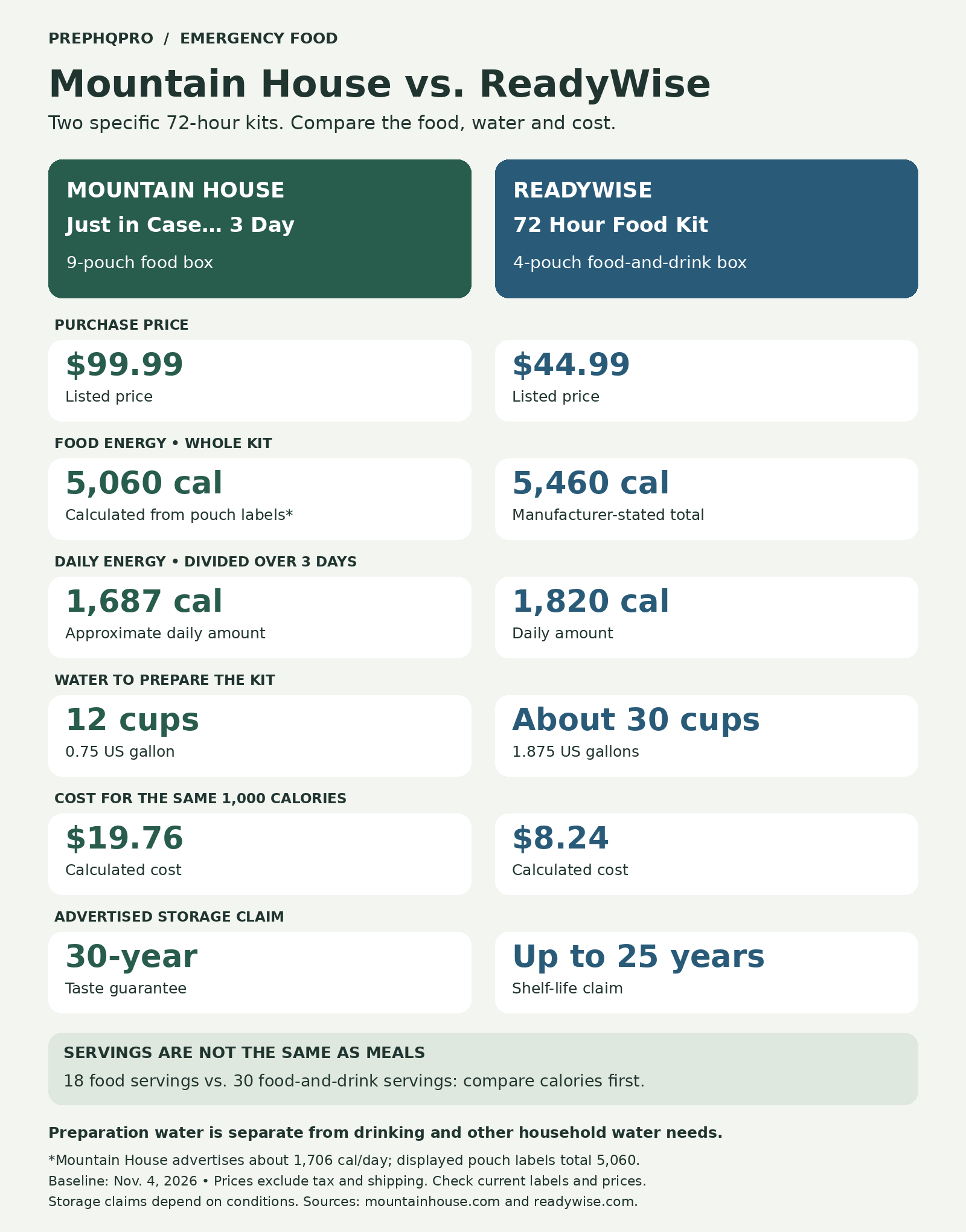
Sources: Mountain House exact kit and ReadyWise four-pouch kit. Prices exclude tax and shipping.
Pro Tip: Do not compare these two on any single row. The price gap looks huge until you factor in water, fuel, and the food you would need to add.
Cost per 1,000 calories helps compare value, but does not measure nutritional balance.
What Is Included in Each Kit?
Mountain House Nine-Pouch Box
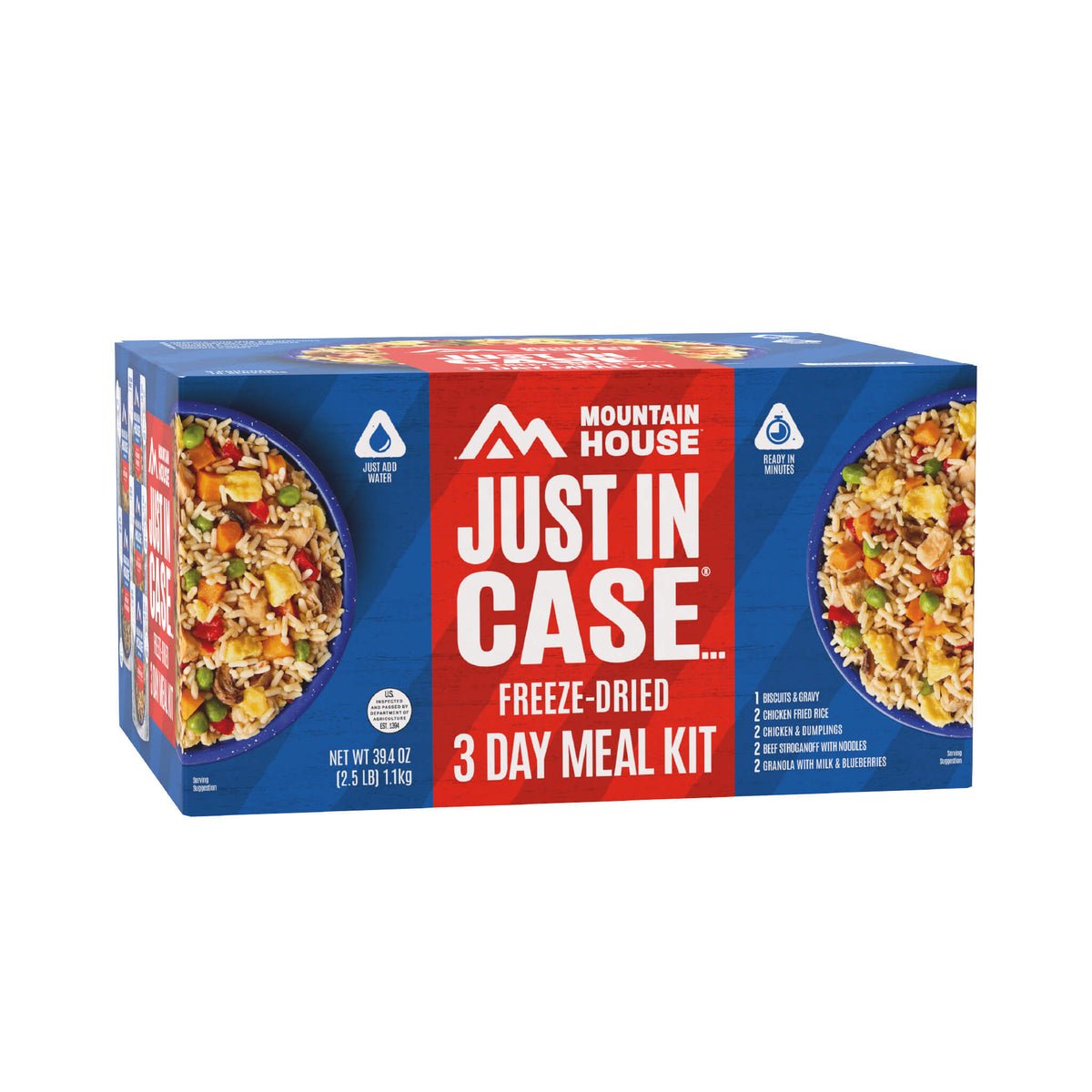
The Mountain House kit is built around full entrées and breakfasts. You get two granola-with-milk-and-blueberries pouches, one biscuits-and-gravy pouch, two chicken fried rice pouches, two chicken and dumplings pouches, and two beef stroganoff pouches.
That is a recognizable menu, the kind of food you can actually picture eating, and the pouch count maps easily onto a three-day schedule.
If you want a closer look, I wrote a separate Mountain House 72-Hour Emergency Food Kit Review.
ReadyWise Four-Pouch Box
The ReadyWise box is built differently. It includes six servings each of cheesy macaroni, teriyaki rice, and brown sugar and maple multigrain cereal, plus twelve servings of whey milk alternative.
Four large pouches hold all of it.
The packaging is compact, but each pouch is a multi-serving bag you’ll portion out yourself.
Thirty servings sounds like thirty meals, and it is not. Twelve of those servings are a whey milk alternative, which is a beverage.
Only eighteen are food servings.
The big number on the box is real, but it measures something different from what most people assume.
Be Careful: ReadyWise Has Two Different 72-Hour Kits
This one trips people up, so it gets its own section. ReadyWise sells a five-pouch 72 Hour Emergency Food Kit and a four-pouch 72 Hour Food Kit.
The names are nearly identical, the boxes look related, and the specs are not interchangeable.
| Five-pouch figure (Nov. 4, 2026 baseline) | Value |
|---|---|
| Listed price | $49.99 |
| Advertised servings | 36 |
| Total calories | 6,780 |
| Calories per day | 2,260 |
| Cost per 1,000 calories | About $7.37 |
The five-pouch kit adds a six-serving Pasta Alfredo pouch. Its exact preparation-water total was not established in my research.
The manufacturer’s general one-cup-per-serving average points to 36 cups, but that is an estimate, not a verified kit total.
Do not apply the four-pouch kit’s 30-cup figure to this one.
Key Insight: Similar product names are one of the easiest ways to buy the wrong thing. Open the exact product page, confirm the pouch count and servings, and only then trust any number you have read elsewhere, including the ones in this article.
Do These Kits Provide Enough Calories for Three Days?
To judge this, I use 2,000 calories a day, or 6,000 over three days, as an arithmetic benchmark. That is a labeling reference and not a personal prescription.
Actual needs vary with age, body size, activity and other individual factors.
| Kit | Difference from 6,000 calories |
|---|---|
| Mountain House nine-pouch box | 940 below |
| ReadyWise four-pouch box | 540 below |
| ReadyWise five-pouch box | 780 above |
Neither of the two main contenders reaches the benchmark on its own. That surprised me when I first ran the numbers, because the “72-hour” label feels like it should cover you.
The five-pouch ReadyWise is the only one of the three that clears it, by 780 calories over the full three days. That does not guarantee enough food for every individual.
These figures also assume you eat every listed calorie with zero waste. Allow for foods your household will not eat and portions you cannot safely save. I would plan on filling the gap with shelf-stable foods that need no water, like peanut butter, nuts, crackers, and tuna pouches.
A calorie surplus alone does not prove a complete diet either, since calories say nothing about protein, fiber, or micronutrients.
A Note on the Mountain House Calorie Discrepancy
The Mountain House overview states about 1,706 calories per day, which would mean roughly 5,118 over three days.
The pouch figures on the labels add up to something different:
(2 × 500) + 540 + (2 × 600) + (2 × 600) + (2 × 560) = 1,000 + 540 + 1,200 + 1,200 + 1,120 = 5,060
Divide that by three, and you get about 1,687 per day. The difference is approximately 19 calories per day, or 58 calories across the whole kit, relative to multiplying the rounded overview figure by three.
It’s a good reminder that overviews and labels can disagree.
I use the label-based total throughout this article unless updated labels resolve the difference. The ReadyWise 5,460 figure is the manufacturer’s stated number, which I have not independently summed.
Pro Tip: Get in the habit of adding up pouch labels yourself. Multiply each pouch’s calories per serving by its servings, then add the pouch totals. Use the labels on the actual kit you receive.
How Much Preparation Water Will You Need?
This is where the two kits really split apart. Mountain House needs 12 cups.
The ReadyWise four-pouch box needs about 30.
That is an 18-cup gap, or 1.125 US gallons.
At roughly 8.34 pounds per gallon, that’s about 9.4 pounds of extra water. If you are sheltering in place, that number mostly turns into a storage and planning question.
If there is any chance you will have to carry your supplies, it matters a lot more, because freeze-dried food is light precisely because the water has been removed. Adding it back in the field gives away some of that advantage.
It helps to think of water as a budget per 1,000 calories. Mountain House works out to about 2.37 cups per 1,000 calories (12 cups for 5,060 calories), while the ReadyWise four-pouch comes to about 5.49 cups per 1,000 (30 cups for 5,460).
Those are calculated figures, and I find them more useful than a raw cup count because they let you compare kits of different sizes fairly.
One caveat is worth knowing. Some of the ReadyWise water goes toward the whey milk alternative, which is a beverage, so part of that 30 cups is drink, and part is food preparation.
Preparation water is also separate from your drinking and household water plan. Avoid accidentally allocating the same water twice when planning drinking, food preparation and sanitation.
Treat it as its own line item, and see my guide to planning water for a 72-hour emergency kit.
Fuel, Stoves and Leftovers
Water is not the only thing you have to bring. Neither food box includes a stove or fuel. However, the total preparation-water figures are not measures of hot-water demand: some water is used for drinks, and approved preparation methods vary.
If your plan is a camp stove, that is a real cost and a real weight, and it is easy to forget until you are staring at a pouch with nothing to heat it.
Follow each pouch’s directions for water, heating, equipment, and portions. Do not assume cold-water or in-pouch preparation is approved for every recipe; follow the specific package directions. Mountain House says cold water can rehydrate its meals, with roughly twice the waiting time. ReadyWise’s general FAQ also describes hot- or cold-water preparation; confirm the instructions for each item in your kit.
Pouch directions also differ between recipes. If heating water, estimate fuel from the actual hot-water quantities, stove efficiency and conditions rather than the entire kit’s water total. CDC advises never using a portable camping stove inside a home, tent or camper.
Leftovers deserve a mention too. USDA guidance says to refrigerate perishable leftovers promptly and never leave them out more than two hours, or one hour when temperatures exceed 90°F (32°C). Without safe cold storage, discard leftovers that exceed those limits.
Prepare only what you will eat.
Which Offers Better Value?
The fairest way to compare cost is price per 1,000 calories rather than price per advertised serving, since serving sizes differ so much between the two brands. The formula is price ÷ total calories × 1,000.
Mountain House comes out to about $19.76 per 1,000 calories ($99.99 ÷ 5,060 × 1,000). The ReadyWise four-pouch comes in at about $8.24 ($44.99 ÷ 5,460 × 1,000), and the five-pouch at about $7.37 ($49.99 ÷ 6,780 × 1,000).
On that measure, the four-pouch ReadyWise costs roughly 58% less per 1,000 calories, a difference of about $11.52.
I would still be careful about declaring a winner from that alone. Cost per 1,000 calories ignores protein, fiber, and micronutrients, and the cheapest calories are not automatically the best kit.
For a truer picture, add in delivered price, the water you will store, the fuel you will burn, any equipment you need, and the food you plan to supplement with.
Sale prices can also distort the comparison, so recheck availability and delivery timing before ordering, especially in storm season.
How Does the ReadyWise 170-Serving Bucket Fit In?
The ReadyWise 170 Serving Emergency Food Apocalypse Bucket is a different product entirely. It is a larger reserve, separate from both 72-hour boxes, and it solves a different problem.
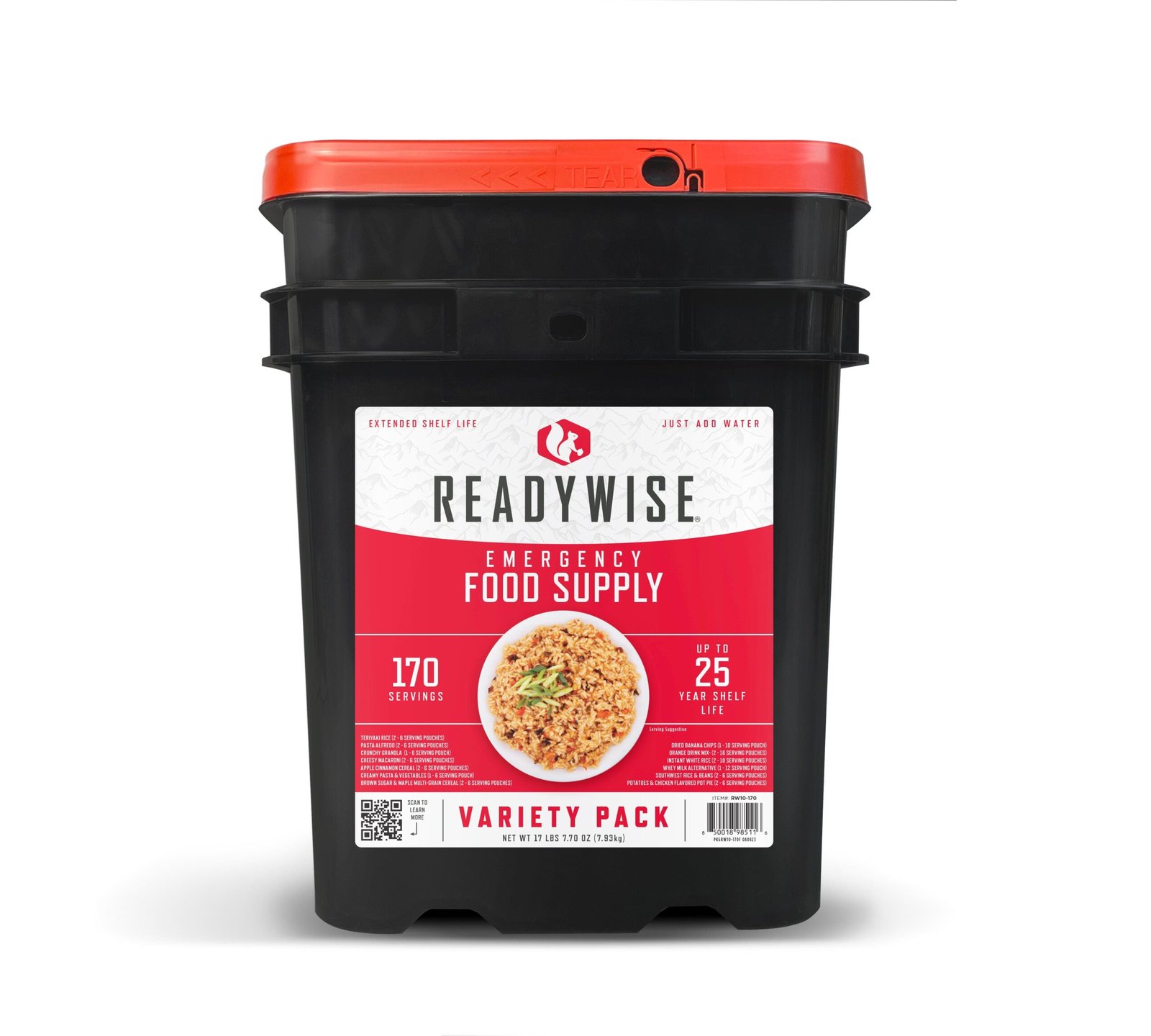
My ReadyWise Emergency Food Bucket Kit Review covers the bucket only.
It is not hands-on testing of either small box, so I would not use it to judge them.
Choose the reserve size around your household’s menu, storage and preparation needs; a large bucket is not automatically a better or worse first purchase. Verify the bucket’s current price and calories on the manufacturer’s listing before relying on any figure.
Common Problems and How to Avoid Them
The first is trusting the label. “72-hour” is a time frame and not a nutrition guarantee, and a kit intended for one person should not be assumed to cover four people for three days.
Check calories and servings against your household’s real size and needs, and plan appropriate pet food separately.
The second is confusing servings with meals. The ReadyWise 30 servings include 12 drink servings, so the food count is 18.
Always separate beverage servings from entrée servings before you compare.
The third is the wrong-listing purchase. With two similarly named ReadyWise kits, it is easy to order one while reading the specs of the other.
Confirm the configuration on the product page.
The fourth is forgetting the hidden logistics: water, fuel, a stove, and a place to store a bulky box in a small apartment. These rarely show up on the box, and they add up.
The fifth is overconfidence in shelf life. “30-year taste guarantee” and “up to 25 years” are different kinds of claims, one a taste guarantee and the other a shelf-life estimate, so they are not directly comparable.
Both depend on storage conditions.
Follow each manufacturer’s storage requirements and inspect the packaging. Cool, dry storage helps preserve quality; a printed year count is not an unconditional guarantee.
The last is skipping the ingredient check. Pouch entrées can be high in sodium, and common allergens like milk, wheat, soy, and egg turn up often.
Whey milk alternative still contains milk-derived ingredients, so read the label if dairy is a concern.
Check each recipe rather than assuming the entire kit suits a dairy-free, vegetarian or other restricted diet.
Tips for Different Scenarios
For a go-bag, pack weight is the main constraint. Mountain House’s lower water requirement is a real advantage if you may need to carry both food and water, since the difference is about 9.4 pounds.
For sheltering in place at home, value matters more than weight. The lower cost per 1,000 calories on the ReadyWise kits is attractive, as long as your water supply and preparation equipment match the pouch directions.
For a power outage, think about how you will cook. If your plan is a camp stove, check which items require hot water and rehearse outdoors with your actual equipment. Do not infer fuel requirements from total preparation water alone.
For a family, do the multiplication honestly. A box that works for one adult does not scale by hoping.
Children and older adults may need different amounts, so build a menu rather than counting boxes.
For dietary restrictions, read the full ingredient list on the exact product. Don’t assume a kit includes a gluten-free or dairy-free option, because the menus are narrow.
A dual-kit strategy can also make sense: one compact kit for the go-bag and one cheaper bulk-calorie kit for home. Different buyers may prioritize different things, whether that is calories per dollar or calories per pound carried.
How This Builds on the Basics
If you are new to emergency food, the basics are simple: store some food, store some water, and know where both are. This comparison builds on that by asking sharper questions.
Instead of “do I have food,” you ask how many calories it really delivers, how much water it uses, what it costs per 1,000 calories, and what it demands from your stove and storage space.
That shift, from counting items to auditing numbers, is the real skill here, and it carries over to every other kit you will ever consider. Massachusetts emergency-management guidance recommends at least a three-day supply of nonperishable food that does not need cooking. Include ready-to-eat options alongside any rehydration kits.
Choosing between brands is on you.
From here, the natural next steps are building a daily menu, adding no-water foods to close your calorie gap, and learning to rotate and track your inventory. For wider options, see my beginners emergency food kit comparison.
Exercises to Reinforce What You Have Learned
Audit a label. Take any kit you own or are considering and add up the calories on every pouch yourself. Compare your total to the box’s claim and note any gap.
Run your own cost math. Use price ÷ total calories × 1,000 on two kits you are weighing, then calculate cups of water per 1,000 calories for each.
Do a menu rehearsal. Prepare one pouch during a mock outage; use an outdoor stove only outdoors according to its instructions. Time it, measure your fuel use, and see whether your family will actually eat it.
Build a gap list. Calculate how far your chosen kit falls short of your household’s three-day calorie target, then list the no-water, shelf-stable foods you would add to cover it.
Sample before you buy. Order a single pouch before committing to several kits. It is cheap insurance, and since I have not tested these kits side by side, I will not name a taste winner.
Frequently Asked Questions
What is the difference between Mountain House and ReadyWise?
For the exact boxes compared here, Mountain House has nine two-serving pouches and ReadyWise has four larger multi-serving pouches. ReadyWise costs less per calorie; Mountain House has a lower total preparation-water requirement. The ReadyWise total includes a beverage.
How many calories are in a 72-hour emergency food kit?
It varies a lot by brand. The kits covered here range from about 5,060 to 6,780 calories for three days, and only one of them clears a 6,000-calorie benchmark.
How much water do you need for freeze-dried emergency food?
There is no single water amount that applies to all pouches; follow each recipe’s directions. The Mountain House nine-pouch kit needs 12 cups total, while the ReadyWise four-pouch kit needs about 30.
Is a 3-day emergency food supply enough?
A three-day supply is a starting point in the emergency-management guidance linked above; plan for local risks and household needs. A three-day kit works best as a base that you add to over time.
How long does freeze-dried food last?
The specific kits here advertise a 30-year taste guarantee or up to 25 years of shelf life. These are conditional manufacturer claims, not a universal lifespan for all freeze-dried foods. Follow package storage guidance.
What is the cheapest 72-hour food kit?
On cost per 1,000 calories, the ReadyWise five-pouch kit came out lowest in this comparison at about $7.37. Cheap calories do not guarantee balanced nutrition, so check protein and sodium too.
Do emergency food kits need to be cooked?
Some meals can be rehydrated with cold water when the manufacturer permits it; others have different preparation requirements. A stove is needed only when your chosen method requires heating and no other suitable heat source is available. Follow each pouch’s directions.
Are ReadyWise 72-hour kits gluten-free?
The menus in these kits are narrow and include wheat-based items like macaroni and multigrain cereal. Read the full ingredient list on the exact product before buying.
What should I add to a 72-hour food kit?
Shelf-stable foods that need no water work best, such as peanut butter, nuts, crackers, tuna pouches, and dried fruit. These help close the calorie gap.
Is the ReadyWise 170-serving bucket worth buying?
It may suit a larger reserve if its recipes, portions, water needs and storage fit your household. The order in which you buy supplies is less important than having a workable plan. Check its current price and calories on the manufacturer’s listing first.
Key Takeaways
A “72-hour” label is a time frame and not a calorie or nutrition guarantee. Mountain House lists about $19.76 per 1,000 calories versus about $8.24 for the ReadyWise four-pouch and $7.37 for the five-pouch, but the cheapest calories don’t automatically make the best kit.
ReadyWise’s “30 servings” includes 12 drink servings, so compare food servings to food servings.
The water gap of about 18 cups, or roughly 9.4 pounds if all preparation water is carried, affects planning, and preparation water is separate from your drinking supply. Verify the exact product, because ReadyWise sells two similarly named 72-hour kits with different specs, and recheck every price and label before you buy.
Find the configurations discussed
Search Amazon for the Mountain House nine-pouch three-day kit or search Amazon for the ReadyWise four-pouch food-and-drink kit. These are search links, not verified exact-product listings. Check pouch counts, food and drink servings, and package labels against this article; other 72-hour versions have different contents.
Sources and Method
Product details and calculations checked November 4, 2026. Prices are listed prices, not delivered costs. Coverage assumes all listed calories are eaten. The five-pouch ReadyWise water estimate is not a verified total.
- Mountain House nine-pouch kit — contents, nutrition, price, water and storage claim.
- ReadyWise four-pouch kit — contents, stated calories, water, price and storage claim.
- ReadyWise five-pouch kit — configuration, stated calories, price and general water estimate.
- Preparation and food-safety sources are linked beside the relevant statements above.