
We may earn money or products from the companies mentioned in this post.
Augason Farms sells this bucket as a one-person, 30-day food supply. This review covers the current 30-Day 1-Person Emergency Food Supply Kit with 194 servings, 23 pouches, and 10 varieties.
Our short verdict: it can be a useful stored-food component for someone who can cook and add other food. Check its advertised daily energy before treating it as your only food for a month.
This is a researched review, not a hands-on test. Product details, prices, availability, the maker’s FAQ and refund policy were checked November 16, 2026. Prices and shipping estimates can change. See how we review emergency food kits.
Augason Farms 194 servings: key specs and quick verdict
| Item | Manufacturer listing (checked November 16, 2026) |
|---|---|
| Advertised servings | 194 (172 food, 22 drink) |
| Pouches and varieties | 23 pouches, 10 varieties |
| Advertised daily average | 1,290 calories, 36 g protein |
| Listed price | $182.99 before shipping and tax |
| Preparation | Most meals need water and 12 to 15 minutes of cooking |
| Availability | Backordered; site banner says emergency-kit orders will ship in December |
Source: official Augason Farms 194-serving product listing.
Keep three terms apart as you read. A serving is the label’s portion size, and a meal is what someone eats in one sitting. A day of food depends on that person’s needs.
Strengths backed by the listing:
- One bucket holds 10 varieties, including a drink, for long-term storage.
- The maker publishes its daily calorie and protein averages, so you can plan around any gap.
Limitations backed by the listing:
- The advertised 1,290 calories a day may be inadequate for many adults.
- Most items need a pot, heat, and cooking time.
- Backorder status makes it a weak pick for an approaching deadline.
Check the current price and stock status for the Augason Farms 30-day kit.
What’s in the 23 pouches, and why 194 servings aren’t 194 meals
The current listing names nine foods and one drink mix. Servings per pouch below are our own math. We divided listed servings by pouch count, so these aren’t numbers independently read from pouch labels.
| Recipe | Pouches | Servings per pouch (calculated) | Total servings | Allergens on kit website (verify on pouch) |
|---|---|---|---|---|
| Brown Sugar Oatmeal | 3 | 8 | 24 | Milk, soy |
| Buttermilk Pancake & Waffle Mix | 2 | 8 | 16 | Egg, milk, wheat |
| Strawberry-Flavored Creamy Wheat | 2 | 8 | 16 | Milk, soy, wheat |
| Creamy Rice & Vegetables | 3 | 8 | 24 | Milk, soy |
| Cheesy Broccoli Rice | 3 | 8 | 24 | Milk declared; ingredients also list soy lecithin |
| Spanish Rice | 3 | 8 | 24 | Soy |
| Fettuccine Alfredo | 1 | 4 | 4 | Milk, soy, wheat |
| Creamy Potato Soup | 3 | 8 | 24 | Milk, soy, wheat |
| Vegetable Stew | 2 | 8 | 16 | Soy, wheat |
| Whey Milk Drink | 1 | 22 | 22 | Milk, soy |
| Total | 23 | — | 194 | — |
Of those 194 servings, 22 are the Whey Milk Drink, which leaves 172 food servings. Spread over 30 days, that’s about 5.7 food servings a day. We couldn’t confirm current per-serving calorie panels for every recipe, so we don’t list calories by recipe.
The food leans on grains and rice. Breakfast items make up 56 servings, rice dishes 72, and soup, stew, and pasta 44. Fettuccine Alfredo is a single four-serving pouch.
Not every item is a ready-to-eat or pour-in-hot-water meal. The pancake and waffle mix is a cooking mix. Check its directions for a pan, griddle, or any extra ingredients before counting on it.
Will one bucket really feed one person for 30 days?
The “30 days” label describes the kit’s allocation of about 1,290 calories per day. It does not establish that the bucket provides adequate energy or complete nutrition for a particular person. Someone whose needs exceed that amount will need additional food.
This is our calculation from the advertised average, not a verified sum of every pouch label. We use 2,000 calories only as an easy comparison number, not a recommended intake or survival minimum.
| Editorial calculation | Result |
|---|---|
| Total kit energy (1,290 × 30) | About 38,700 calories |
| Days for one person at 2,000 calories | About 19.4 |
| Daily gap to reach 2,000 calories | 710 calories |
| Extra calories needed over 30 days | 21,300 |
| Days for four people at 2,000 calories each | About 4.8 |
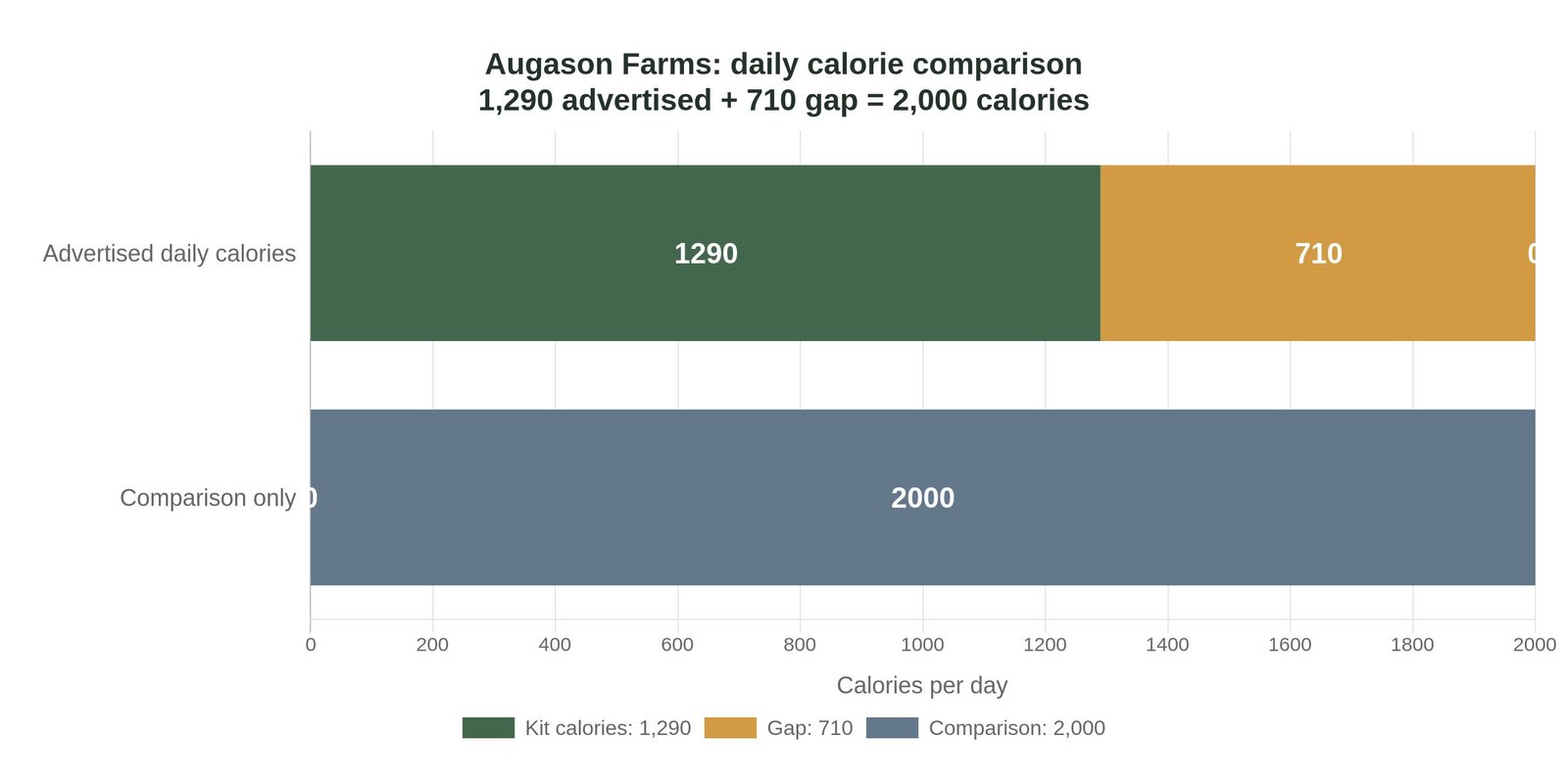
These “calorie-equivalent days” measure energy only. They don’t prove the food is nutritionally complete, that portions split evenly, or that the recipes form sensible daily menus.
Closing a 710-calorie daily gap means storing other food your household already eats and rotates. Use our free emergency food planning worksheet to build a calorie-based emergency food plan before you buy anything else.
Sharing one bucket among four people drops coverage to under five days at the comparison number. Buying one bucket per person covers the headcount, but each person still gets only 1,290 calories a day. Our family emergency food kit guide explains household sizing.
Water, fuel, and cooking gear you’ll need to prepare it
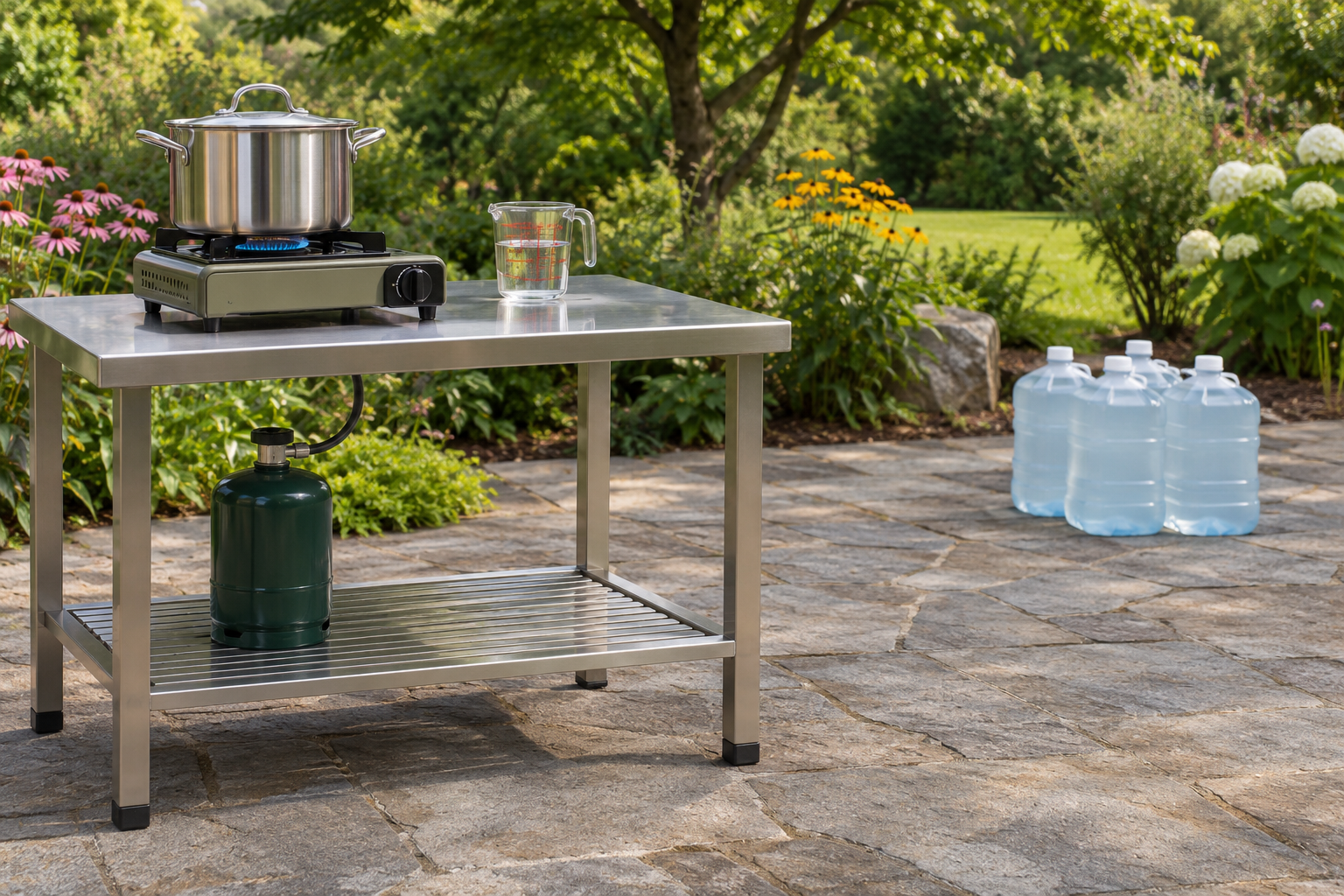
Plan for a pot, a suitable heat source, fuel, measuring cups, and clean water. The maker says each pouch’s directions control the details, including cooking time.
We couldn’t confirm a whole-kit water total for this version. Current directions for all ten products weren’t available. Figures from older 200- or 252-serving buckets don’t apply, and you shouldn’t assume one cup per serving either.
Once you have the bucket, read each pouch and work through these steps:
- Find the water needed per whole pouch, not per serving, for each recipe.
- Multiply by that recipe’s pouch count.
- Add the results, then convert the total to cups and U.S. gallons (16 cups per gallon).
Batch size matters. Most pouches hold eight listed servings, so cooking a whole pouch may need a large pot. If the manufacturer permits partial batches, follow its directions for dividing the dry ingredients and water; don’t assume a scoop contains an even mix.
The long storage claim covers sealed dry food, not cooked food. Without reliable refrigeration or safe hot holding, cook only what you can eat promptly. FoodSafety.gov advises discarding perishable leftovers held above 40°F for two hours or more, or one hour when surrounding temperatures exceed 90°F. A lid does not make leftovers shelf-stable.
Cleanup counts too, since washing pots, bowls, and utensils uses water and sometimes extra fuel to heat it.
Use camp stoves, grills, and other outdoor-only fuel-burning equipment outdoors, away from doors, windows and air intakes, following the maker’s instructions. Never bring them inside a home, garage or tent to cook. See EPA guidance on cooking safely during power outages. Keep a no-cook fallback for conditions that prevent safe outdoor cooking.
CDC advises storing at least one gallon of water per person per day for three days, and trying to store a two-week supply if possible. That minimum includes cooking and other essential uses; it is not a guarantee that one gallon meets every dry-food menu’s needs.
Add up drinking, preparation and hygiene needs separately, then check that your total covers them without counting the same water twice. Increase storage above the minimum when needed; never reduce necessary drinking water to make the menu fit. Our guide to how much water to store for a 72-hour emergency kit walks through containers and amounts.
Allergens and diet limits: milk, soy, wheat, and egg
This kit fits poorly if anyone avoids milk, wheat, or soy. Website declarations in the contents table show milk in most recipes, and soy and wheat appear widely. The pancake mix also declares egg, which a short kit-level summary can miss.
The current kit page declares only milk for Cheesy Broccoli Rice, but its ingredient list also names soy lecithin. That inconsistency needs clarification from the manufacturer. Do not infer wheat-free or other dietary suitability from this web listing; confirm the exact pouch formulation and cross-contact information before relying on it.
Excluding milk-declared recipes removes 132 of 172 food servings plus the drink, leaving 40 listed food servings across Spanish Rice and Vegetable Stew. Excluding recipes explicitly declaring wheat removes at least 76 food servings. These are serving-count calculations, not calorie estimates or a determination that the remaining foods are safe for someone with an allergy.
Don’t assume any recipe is gluten-free, dairy-free, vegan, or low-sodium from its name. We couldn’t confirm current panels for sodium, fiber, added sugars, or per-serving protein for every recipe.
The 36-gram protein figure is an advertised daily average, not proof of complete nutrition. Anyone with allergies or a medical diet should read every pouch, clarify uncertainties with the manufacturer, and discuss individual requirements with their doctor or dietitian.
What does the Augason kit cost per day and per 1,000 calories?
At the listed $182.99, the kit costs about $6.10 per advertised day and about $4.73 per 1,000 calories. Against the 2,000-calorie comparison number, that’s roughly $9.46 per calorie-equivalent day. These calculations use the approximately 38,700 calories derived from the advertised daily average.
None of those figures include shipping or tax. We didn’t get an address-specific delivered quote. The FAQ says current shipping promotions are shown at checkout, so don’t assume free shipping.
Budget separately for extra food, water containers, a stove, and fuel.
See the official Augason Farms listing and confirm the delivered price at checkout.
How it compares with the Emergency Essentials 1-Month kit
We also checked the official Emergency Essentials 1-Month listing on November 16, 2026. It showed a $189.99 price but was marked sold out. Its figures are useful for comparison, not a claim that it can be ordered for immediate delivery.
| Detail | Augason Farms 30-Day (194 servings) | Emergency Essentials 1-Month |
|---|---|---|
| Listed price | $182.99 | $189.99 |
| Total energy | About 38,700 calories (calculated from advertised daily average) | 56,650 calories (manufacturer total) |
| Advertised daily average | 1,290 calories, 36 g protein | 1,888 calories, about 45 g protein |
| Servings and varieties | 194 servings; 10 varieties including drink | 257 servings; specs list 13 varieties including drink |
| Days at 2,000 calories (calculated) | About 19.4 | About 28.3 |
| Price per 1,000 calories (calculated) | About $4.73 | About $3.35 |
| Availability when checked | Backordered; December shipping banner | Sold out; site also carries a general up-to-14-business-day shipping notice |
For $7 more at the displayed price, the Emergency Essentials kit advertises more total energy. Availability currently limits that comparison. It still needs preparation equipment and an allergen check, and its menu includes breads and cornbread whose equipment requirements should be checked. Neither kit is proven cheaper delivered without matching checkout quotes.
Emergency Essentials’ specifications count 13 varieties including the whey milk drink, while some marketing text says 12 food varieties. We use the specifications’ inclusive count here.
Ready Hour and Mountain House kits also appear in category roundups. We didn’t verify their current prices for this review, so they’re left out of this table.
Shelf life claims and how to store the bucket
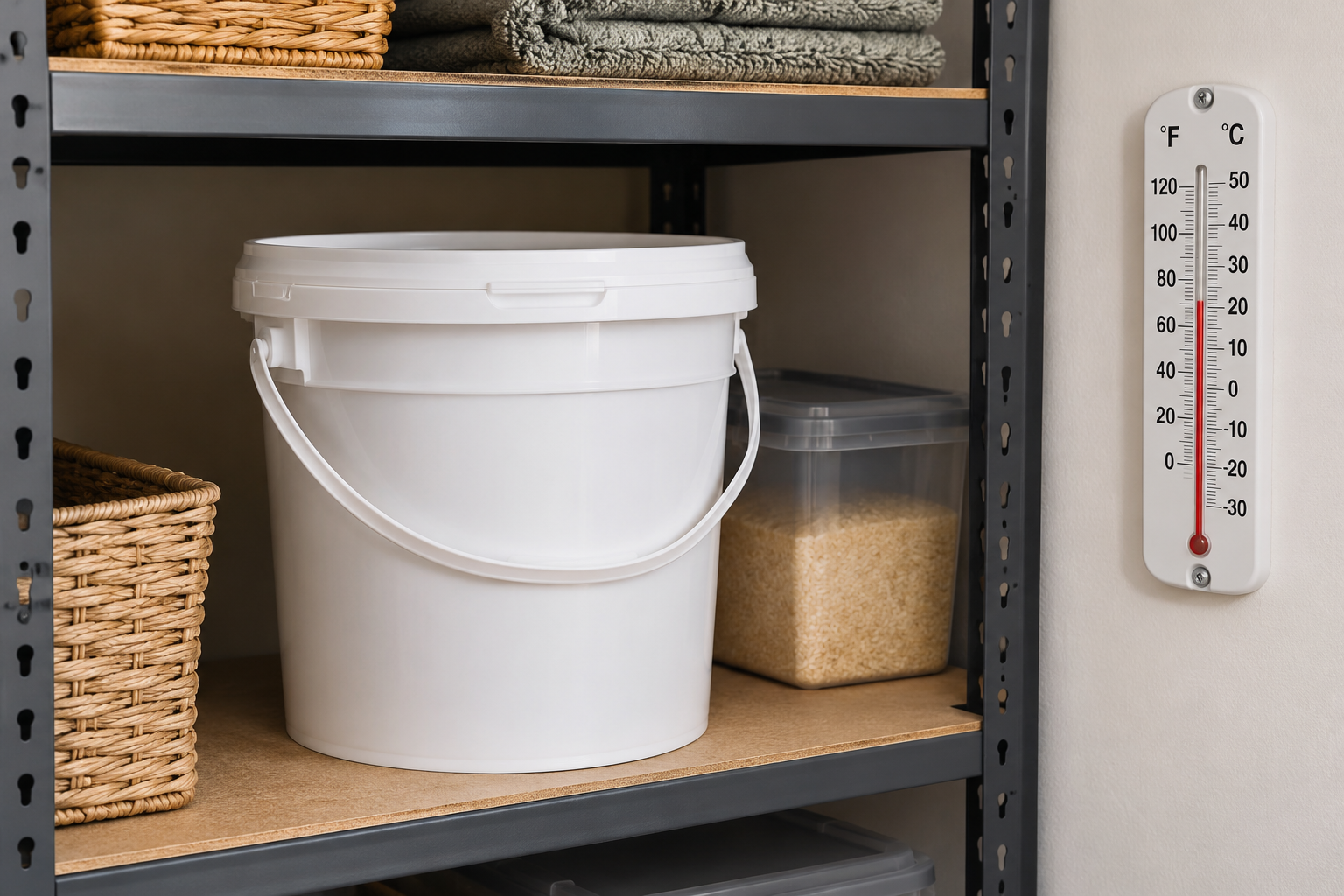
Augason Farms claims the kit lasts up to 25 years, but “up to” depends on storage. Its FAQ recommends a cool, dry spot between 55 and 70°F, away from heat and moisture.
The FAQ says products with eggs or oil generally have shorter lives, yet this kit’s pancake mix text claims up to 30 years. Those statements need product-specific clarification. Follow each pouch’s printed dates and storage instructions, and ask the company about discrepancies before relying on a decades-long reserve.
When the bucket arrives, inspect each pouch for damage and note the printed dates. That makes rotation easier and shows how much storage life remains.
Shipping, returns, and buying questions
Does the shelf-life clock start when I buy it?
No. The FAQ explains calculating a best-by date using the product’s lot-code year and the shelf life on the label. It does not start a new storage period on your purchase date. Some time may pass before the bucket reaches you.
Can I return the kit if I change my mind?
For direct orders, the refund policy says orders are final sale and ordinary returns aren’t accepted. Damaged or defective goods may qualify for a refund or exchange; contact the company within seven days of receipt. Inspect the shipment promptly and retain the order details. Retailer purchases follow the retailer’s policy.
Is the December ship date guaranteed?
The banner gives a month, not a specific dispatch or arrival date, and the listing also says backordered. An Add to Cart button does not prove stock. Confirm timing with the company before ordering for a deadline.
Can I buy this kit from a retailer instead?
Retail partners may carry Augason products, but match the exact version and check availability. Older 200- and 252-serving buckets have different contents, so their figures don’t apply here. Check the title, contents and labels, and expect the retailer’s own return policy. The maker recommends buying products shipped and sold by the retail partner rather than an unverified third-party seller.
Who should buy the Augason Farms 30-day kit, and who should skip it
It may suit an adult who can cook safely during an outage, whose diet accommodates the ingredients, and who will add other food. The main benefit is a single long-storage bucket with several familiar recipe types.
Skip it if you need food within weeks, cannot accommodate its allergens, or can’t cook the meals. It also falls short as a stand-alone full-month option for someone whose daily needs exceed its advertised allocation.
On the displayed prices, the sold-out Emergency Essentials comparator offers more calories per dollar, but availability and delivered cost must be checked before treating either as the better purchase. The evidence supports this bucket as one part of a plan, not proof of a nutritionally complete 30-day supply.
Check the Augason Farms 30-day kit’s current shipping estimate before you order. For food that needs no simmering, see our DIY no-cook ration pack guide and canned-goods selection and rotation guide.
Sources and further reading
- Augason Farms: current 194-serving kit, contents, ingredients and preparation
- Augason Farms: shipping, storage, lot codes and shelf-life FAQ
- Augason Farms: refund policy
- Emergency Essentials: 1-Month kit specifications, price and availability
- CDC: emergency water storage
- FoodSafety.gov: food safety during emergencies
- EPA: power outages and indoor air quality