
We may earn money or products from the companies mentioned in this post.
A four-week food kit sounds like a month of meals for your whole home. The question that matters is whether the food fits your household and whether you can cook it during an outage.
This review covers the standard Ready Hour 4-Week Emergency Food Supply from My Patriot Supply. We used the listing as it appeared on November 17, 2026. Our early answer is conditional: it can work as an organized reserve for one adult if the menu, cooking setup, and delivery timing fit your needs.
We worked from published information and didn’t order, cook, or taste the kit. One issue was still open when we checked. The product page showed "Unavailable," an Add to cart button, and a 10- to 12-week shipping notice.
Quick verdict: the 4-week kit’s key specs on paper
The figures below come from the My Patriot Supply product listing. We did not independently measure them.
| Spec | Manufacturer listing |
|---|---|
| Price | $277.95 (checked November 21, 2026) |
| Total calories | 56,460 |
| Total protein | 1,258 g |
| Servings and varieties | 250 servings across 16 items |
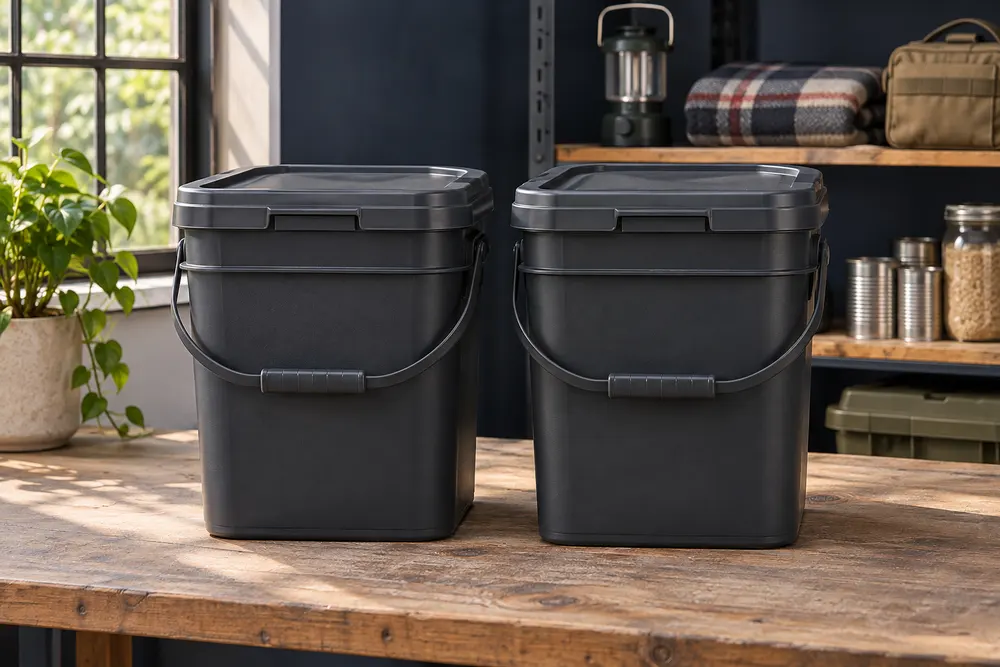
| Packaging and food weight | Two buckets containing 31.65 lb of food |
| Preparation water | 9.14 gallons |
| Shelf life | Up to 25 years with proper storage |
Whether it fits you depends on your household’s diet, heat source, cookware, water supply, and shipping timing.
What the kit does well on paper
- Food-only cost of about $4.92 per 1,000 calories, lower than the alternative we priced.
- A mixed menu of breakfasts, entrées, staples, desserts, a snack, and a drink, packed in two buckets.
- A long shelf-life claim, as long as storage conditions are right.
Where it falls short for many buyers
- It’s one person’s calorie supply for 28 days, not a household’s.
- Some items need real cooking, and we couldn’t get full directions for every pouch.
- Official pages show conflicting specs and ordering signals.
See the current 4-week kit listing and shipping notice.
What’s inside the standard 4-week kit?
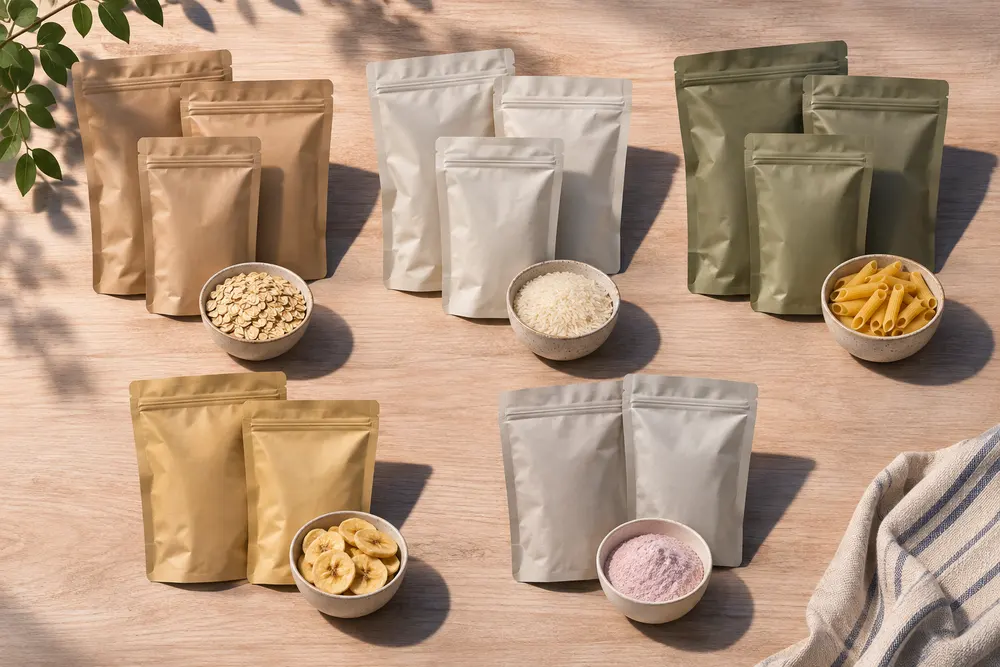
The product page lists 33 pouches and 250 servings. We grouped the items by type, and the counts add up.
| Type | Item | Pouches | Total servings |
|---|---|---|---|
| Breakfast | Buttermilk Pancake Mix | 3 | 30 |
| Breakfast | Maple Grove Oatmeal | 4 | 32 |
| Breakfast | Strawberry Flavored Creamy Wheat | 1 | 8 |
| Entrée | Chili Mac | 1 | 8 |
| Entrée | Creamy Stroganoff | 2 | 8 |
| Entrée | Creamy Chicken Flavored Rice | 4 | 16 |
| Entrée | Creamy Risotto | 2 | 16 |
| Entrée | Mac & Cheese | 2 | 8 |
| Entrée | Southwest Rice | 3 | 24 |
| Entrée | Creamy Alfredo Pasta | 1 | 4 |
| Staple | Long Grain White Rice | 3 | 30 |
| Baking mix | Honey Wheat Bread Mix | 2 | 24 |
| Dessert | Chocolate Pudding | 1 | 10 |
| Dessert | Rice Pudding | 1 | 8 |
| Snack | Banana Chips | 2 | 16 |
| Drink | Orange Flavored Energy Drink Mix | 1 | 8 |
| Total | 33 | 250 |
A serving is a portion, not a full meal. Plain rice, bread, pudding, banana chips, and drink servings add calories, but none replaces dinner on its own.
We left out calories per serving, allergens, and cooking method by item. The site’s Nutrition & Directions panel only showed a loading screen, and we won’t fill those cells with guesses. The name Creamy Chicken Flavored Rice doesn’t confirm that it contains meat.
Why another official page shows different numbers
A separate My Patriot Supply landing page lists Chili Beans and Mac and Mushroom Rice Pilaf instead of matching product-page names. It also reports 56,140 calories, 1,176 g protein, 38 lb, and 9.8 gallons of water.
The pages give conflicting figures, so we use the specific product listing for the calculations below. The store allows substitutions, so recheck totals against what actually ships. This standard kit is also separate from the MEGA version. It’s separate from bundles that add filters, stoves, fuel, or power gear, too.
How long does 56,460 calories last per person?
About 28 days for one person eating 2,000 calories a day. For four people at that same intake, it covers roughly one week.
| Household and daily intake | Calculated coverage |
|---|---|
| One person at 2,000 calories | 28.23 days |
| One person at 2,500 calories | 22.58 days |
| Four people at 2,000 calories each | 7.06 days |
| Four people at 2,500 calories each | 5.65 days |
| Average per day over 28 days | 2,016 calories and 44.9 g protein |
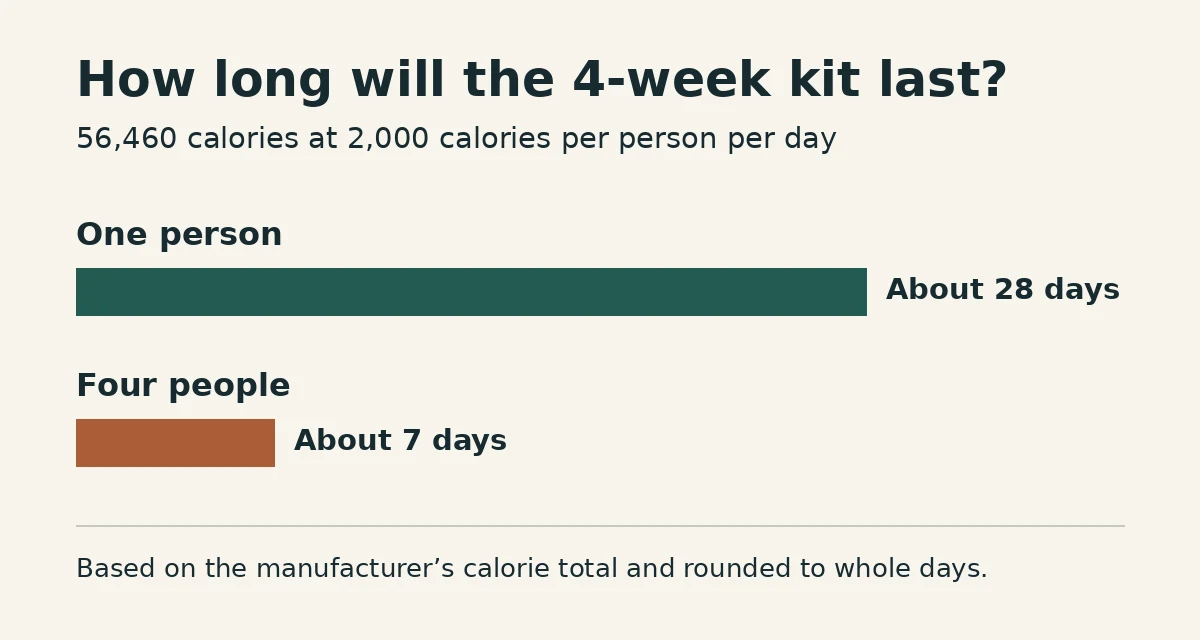
Four weeks means 28 days, not a calendar month. The 2,000 and 2,500 figures are arithmetic examples, not intake advice or survival requirements.
These results assume your household eats every calorie. Allergies, disliked recipes, and pouches too big to finish all shrink usable coverage. The 44.9 g protein average also doesn’t show that protein is adequate for every reader.
Use our free emergency food planner to calculate your household’s usable food coverage before you decide how many kits make sense.
What "add water and heat" actually involves
Preparing this kit takes more than pouring water into a pouch. Some items need real cooking, even without electricity.
Does every recipe cook inside its pouch?
No. The official pancake mix listing says to mix it with water and cook it on a skillet or griddle. That rules out a blanket "rehydrate in the pouch" plan.
That listing doesn’t confirm exact ratios, oil needs, or cooking times for the kit’s pouches. Get readable directions for all 16 items before you plan fuel. For each one, note:
- Whether it’s ready to eat, rehydrated, simmered, pan-cooked, or baked
- Hot or cold water, and whether timing starts after the water boils
- Pot or pan size, lid, measuring, and stirring needs
- Any baking equipment, such as for the Honey Wheat Bread Mix
- Extra ingredients the label calls for
Can you split a pouch, and what about leftovers?
Only if the label gives a partial-pouch method. These pouches make 4 to 12 servings each, so one adult cooking a 10-serving pancake pouch will have leftovers. Don’t improvise smaller ratios.
FoodSafety.gov advises refrigerating perishable food at 40°F or below within two hours, or one hour above 90°F. Hot food should stay at 140°F or above. Without reliable cold or hot holding, eat batches promptly and throw out food past those limits.
Storage claims for opened dry pouches don’t apply to cooked leftovers.
What equipment and safe heat will you need?
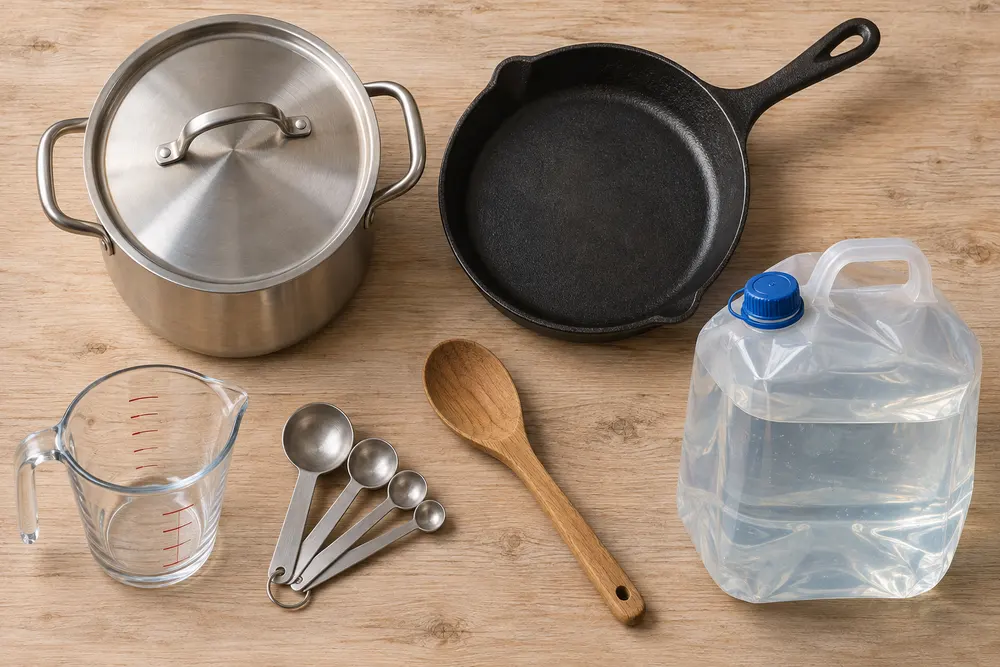
The standard kit is food only, with no stove or fuel. Based on the directions we could confirm, plan for:
- Safe water for cooking and cleanup
- A heat source approved for the place you’ll use it
- A pot, plus a skillet or griddle
- Measuring cups, spoons, and a stirring utensil
- Plates, eating utensils, and cleanup supplies
CDC carbon monoxide guidance says to keep portable gas camp stoves and charcoal outdoors. Follow the stove manufacturer’s instructions. Fuel needs depend on your equipment and the preparation directions for the pouches you receive.
How much water does preparation take?
My Patriot Supply lists 9.14 gallons for the whole kit. Spread over 28 days, that’s about 0.33 gallon a day for preparation only, not drinking water or a full daily supply.
We couldn’t verify that figure because matching labels weren’t available. Once you have them, build a simple worksheet:
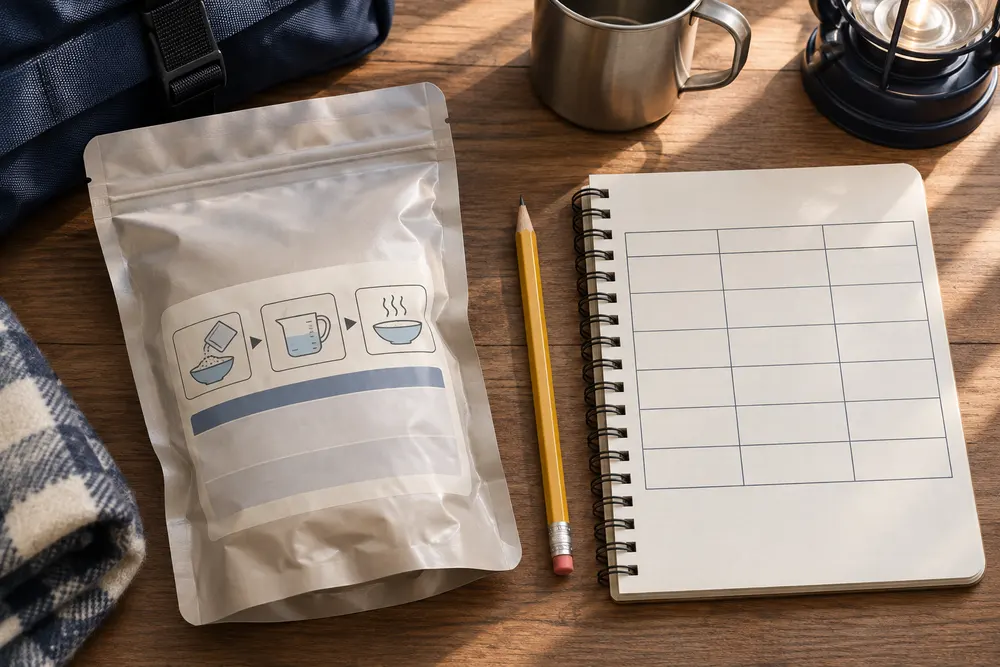
- List each recipe and its pouch count.
- Multiply pouches by the water per pouch on the label.
- Add all rows for a kit total.
- Note whether the drink mix is included.
If your sum differs from 9.14 gallons, ask the company before relying on either number. Don’t swap in the landing page’s 9.8 gallons.
CDC guidance recommends storing at least one gallon per person per day for three days and aiming for two weeks if possible. That water covers drinking, cooking, and other needs. Include preparation water in your household budget so you count it once.
Our guide to planning emergency drinking and cooking water uses a 72-hour frame. Scale your plan to 28 days for this kit.
Ingredients, allergens, and menu limits we couldn’t confirm
Without matching labels, we can’t say which items suit specific diets. Don’t assume any recipe is gluten-free, dairy-free, vegan, low-sodium, or allergy-safe from its name.
Sodium, fiber, added sugars, and the calorie share from drinks and desserts also remain unverified. Check each label if those matter to you, and ask a doctor or dietitian about individual needs.
The seller says the kit supplies 100% of 12 vitamins and minerals. Treat that as a claim tied to eating a daily variety of the foods, not proof of complete nutrition. FDA-related manufacturing language, if you see it, isn’t FDA approval of the product.
Is the 4-week kit worth $277.95?
On food cost alone, it looks competitive. At the November 21, 2026 price, the math works out like this:
- $277.95 ÷ 56.46 (thousand calories) = about $4.92 per 1,000 calories
- $277.95 ÷ 28 days = about $9.93 per advertised day
Prices exclude taxes. Check the seller’s shipping FAQ for the general free-shipping threshold and the product page for the kit’s estimated ship date.
Returns and disaster replacement terms
Terms updated April 20, 2026, require starting a return within 30 days of purchase. Goods must be unopened and unused. You pay return shipping, and original shipping costs may be deducted even when shipping was free.
With a 10- to 12-week shipping notice, ask how that purchase-based window works before ordering. The disaster replacement program is conditional. You must activate it; replacement is at the company’s discretion, and improper storage is excluded.
Your real budget also includes water storage, cookware, safe heat, fuel, cleanup supplies, and extra foods for protein or variety.
One alternative worth comparing
The Emergency Essentials 2-Week True Survival Food Kit cost $374.90 before tax on November 21, 2026. It lists 33,045 calories, 1,505 g protein, ten #10 cans, and 10.80 gallons of preparation water.
It includes pork sausage, fruit, and vegetables, with more protein per calorie. It costs about $11.35 per 1,000 calories and covers a shorter period. Its collection page showed Sold Out while the product page showed Add to cart, so confirm stock.
Who should buy the 4-week kit, and who should choose differently
This kit fits one adult who wants an organized, low-cost-per-calorie reserve and can wait for delivery. It also suits buyers who already have safe heat, cookware, and stored water.
Choose differently if you expect a month of food for a family, need confirmed allergen-safe meals, or need food soon. Skip it too if you have no safe way to cook pancakes, rice, and pasta during an outage.
We recommend it conditionally. Value per calorie is its strength, but item-level directions, labels, and delivery timing still need the seller’s confirmation.